Gallery
Français · Reference · Published, partly reviewed by a person · Applies from: 4.1.19
Screenshots of the sample game, The Pantry Key, and of the local Studio, taken from the real production build and the
real Studio by npm run docs:screenshots, never mock-ups. Each picture has its important labels written out below it.
These captures were taken at 4.1.19 (11 October 2026). Since then the interface font changed (Galmuri11, 4.3.0), the hero can be chosen at New Game (4.3.0), and the Studio gained a hero × language matrix and before/after captures (4.4.0): none of those shows here yet. To see the current version, play it at wanoo.github.io/quest-n-click.
Audience, context, and the statuses of what this page rests on
Audience: player, author · Context: player's browser
The game
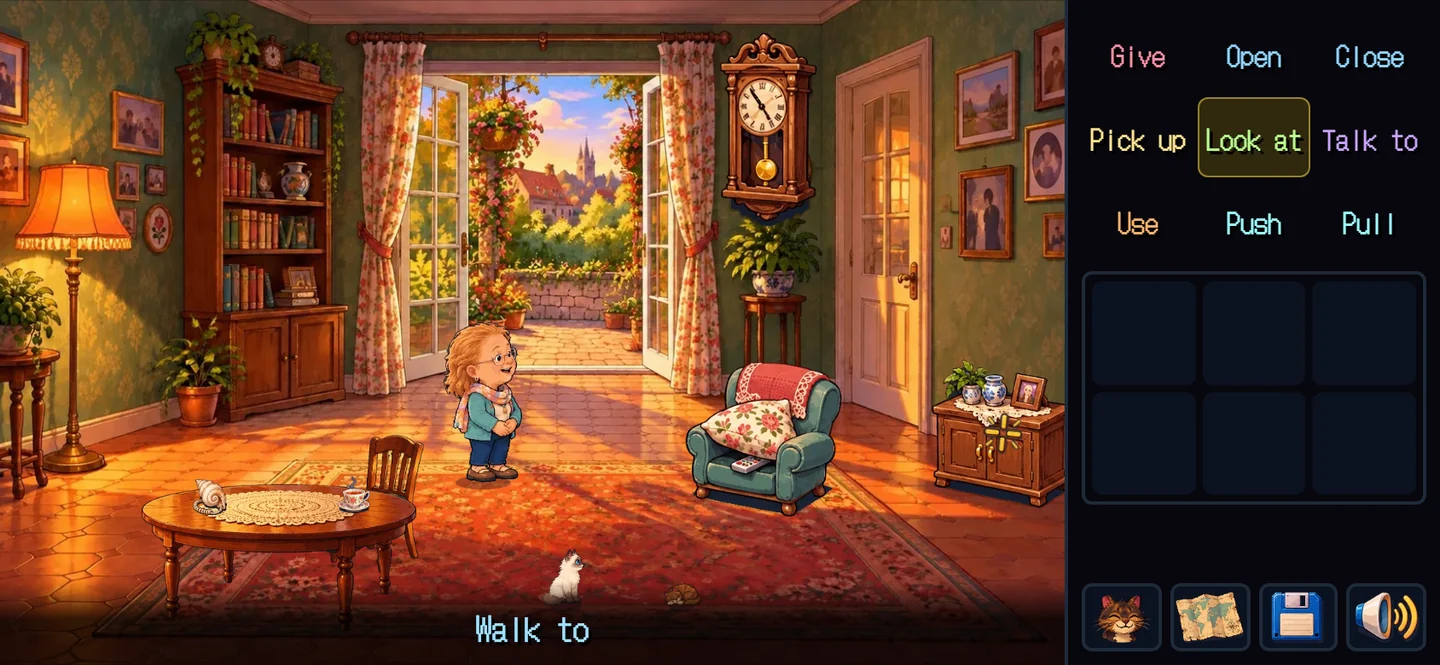
Grandma's living room. On the right, the verbs Give, Open, Close, Pick up, Look at, Talk to, Use, Push, Pull ("Look at" is selected), the bag (six empty slots) and four tools: the other playable character (the cat), the map, the pause menu, the sound. Under the scene, the sentence line: Walk to.
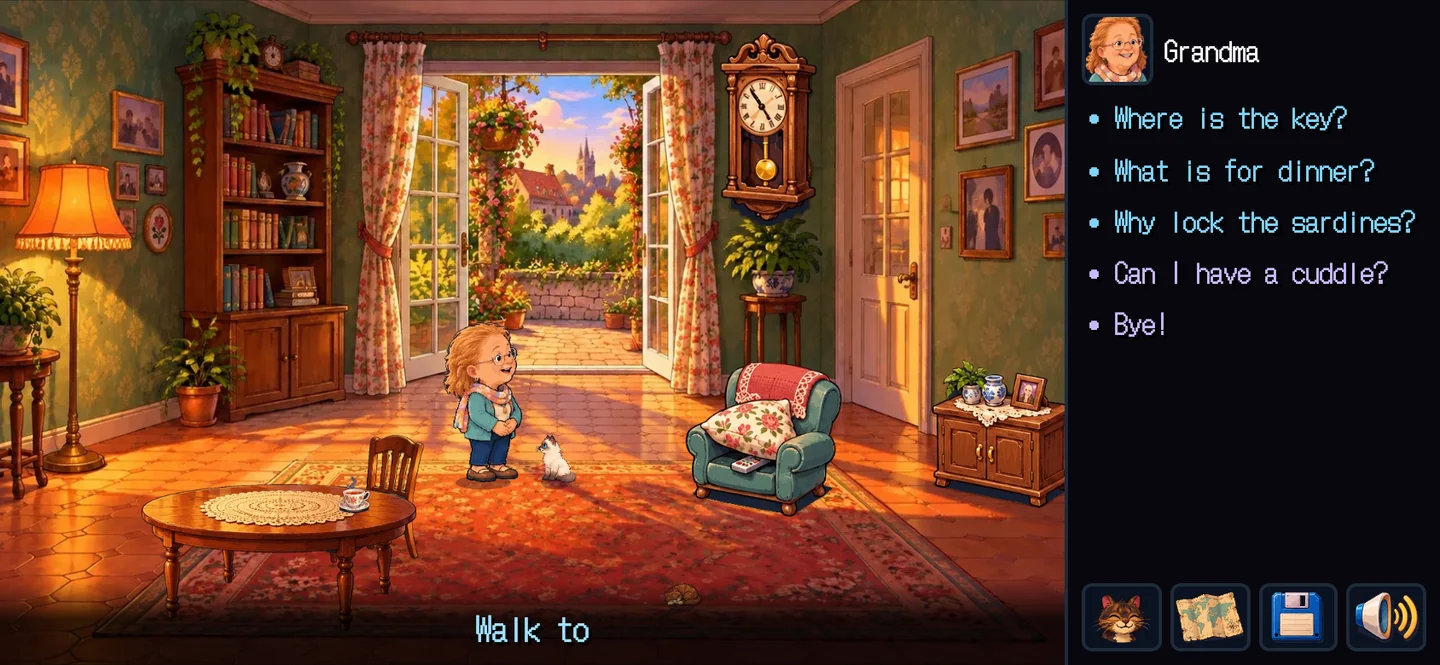
A conversation. The column on the right shows Grandma and her topics: Where is the key?, What is for dinner?, Why lock the sardines?, Can I have a cuddle?, Bye!
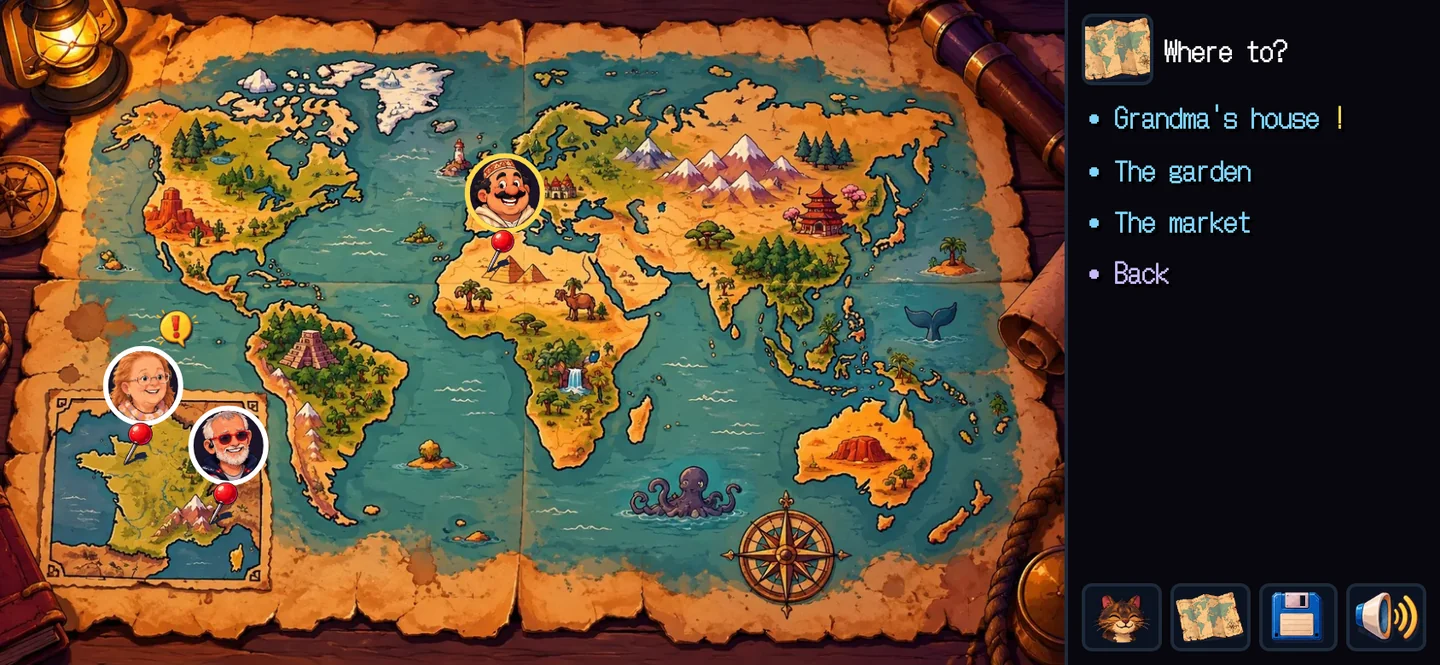
The world map. The characters are pinned where they are; the column asks Where to? with Grandma's house ! (something new there), The garden, The market and Back.
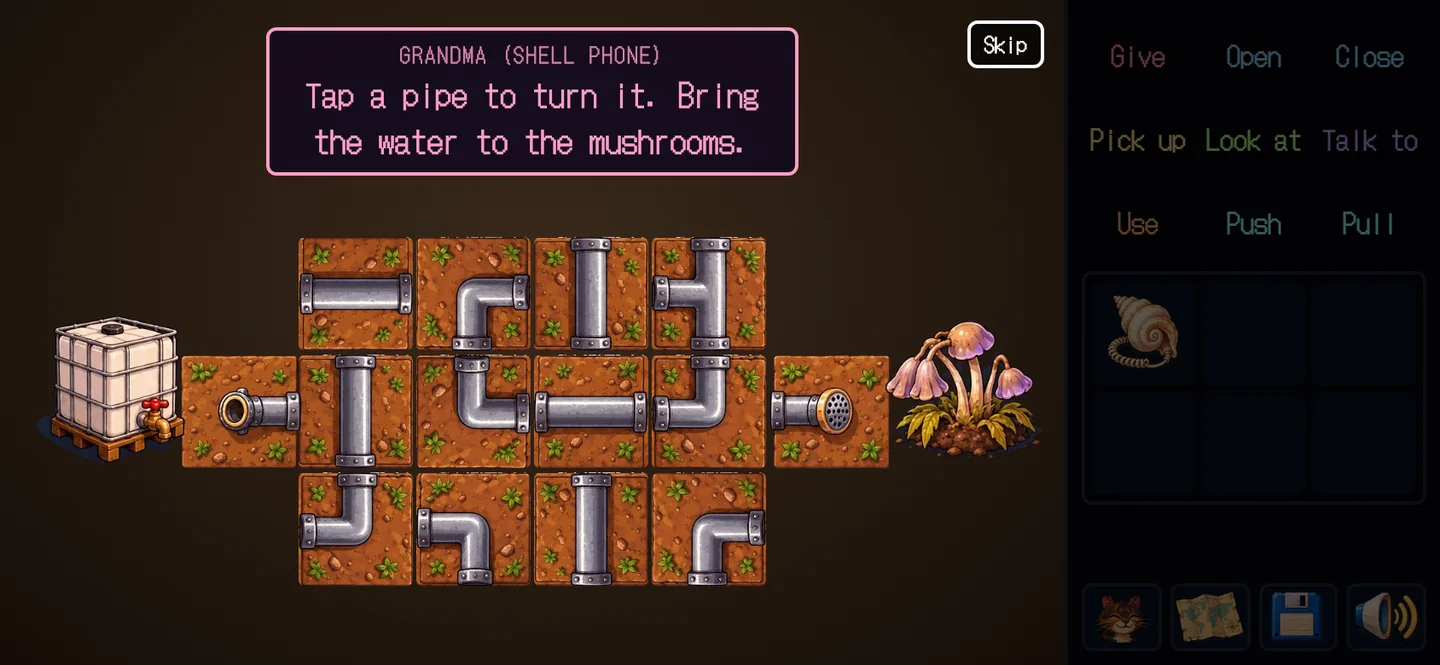
A minigame, pipes. The instruction, from Grandma on the shell phone: Tap a pipe to turn it. Bring the water to the mushrooms. A Skip button at the top right. It plays by touch or with the keyboard.
The Studio
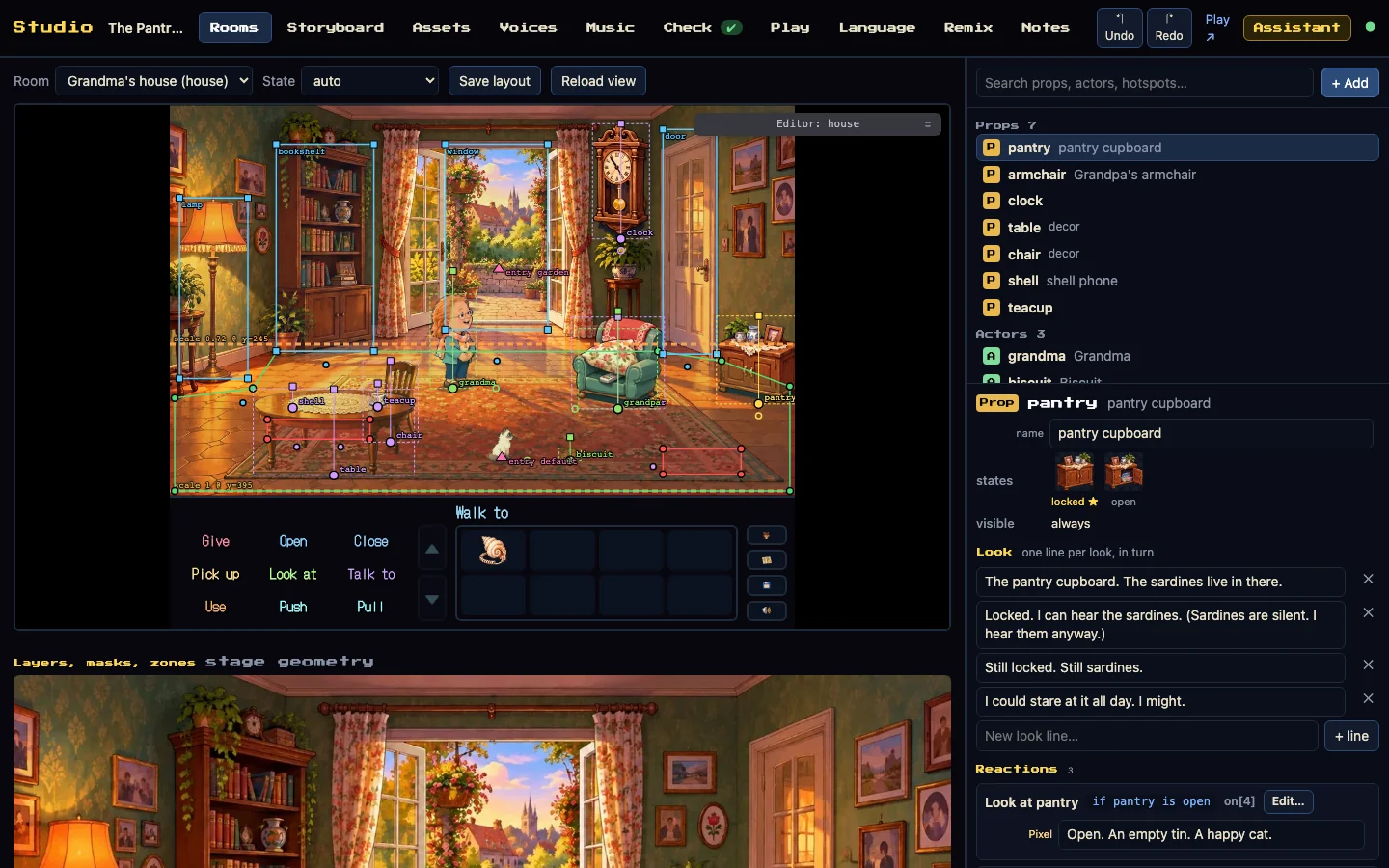
The Rooms tab. The tabs along the top: Rooms, Storyboard, Assets, Voices, Music, Check, Play, Language, Remix, Notes, then Undo, Redo, Play and Assistant. The room Grandma's house (house) in the placement editor; on the right the Props (pantry, armchair, clock, table, chair, shell, teacup) and Actors; the prop pantry selected, with its states locked and open, its Look lines and its Reactions.
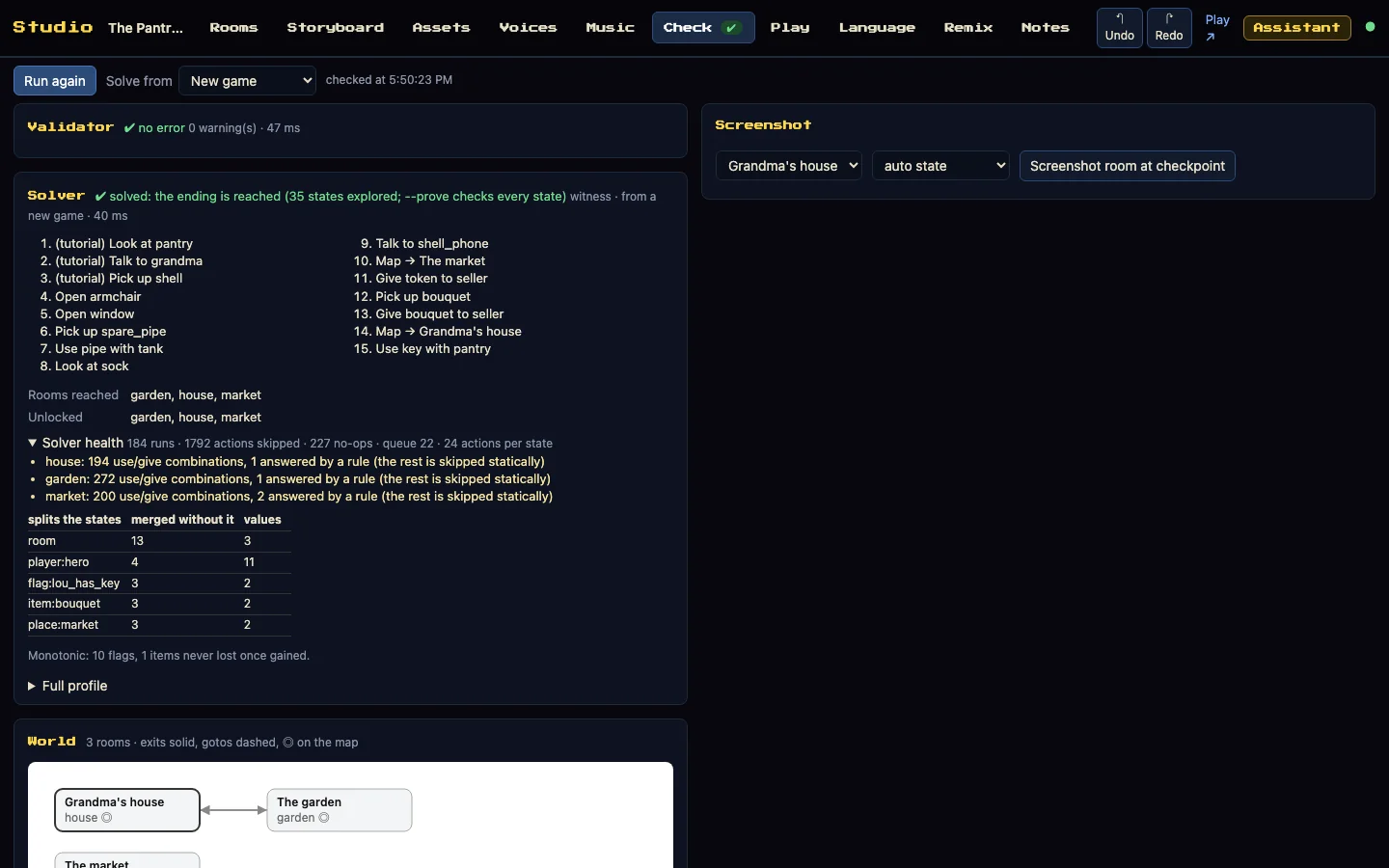
The Check tab. Validator: no error, 0 warning(s). Solver: solved: the ending is reached (35 states explored; --prove checks every state), with its fifteen steps, from "(tutorial) Look at pantry" to "Use key with pantry". Solver health (runs, actions skipped, what splits the states). World: the three rooms and their exits.
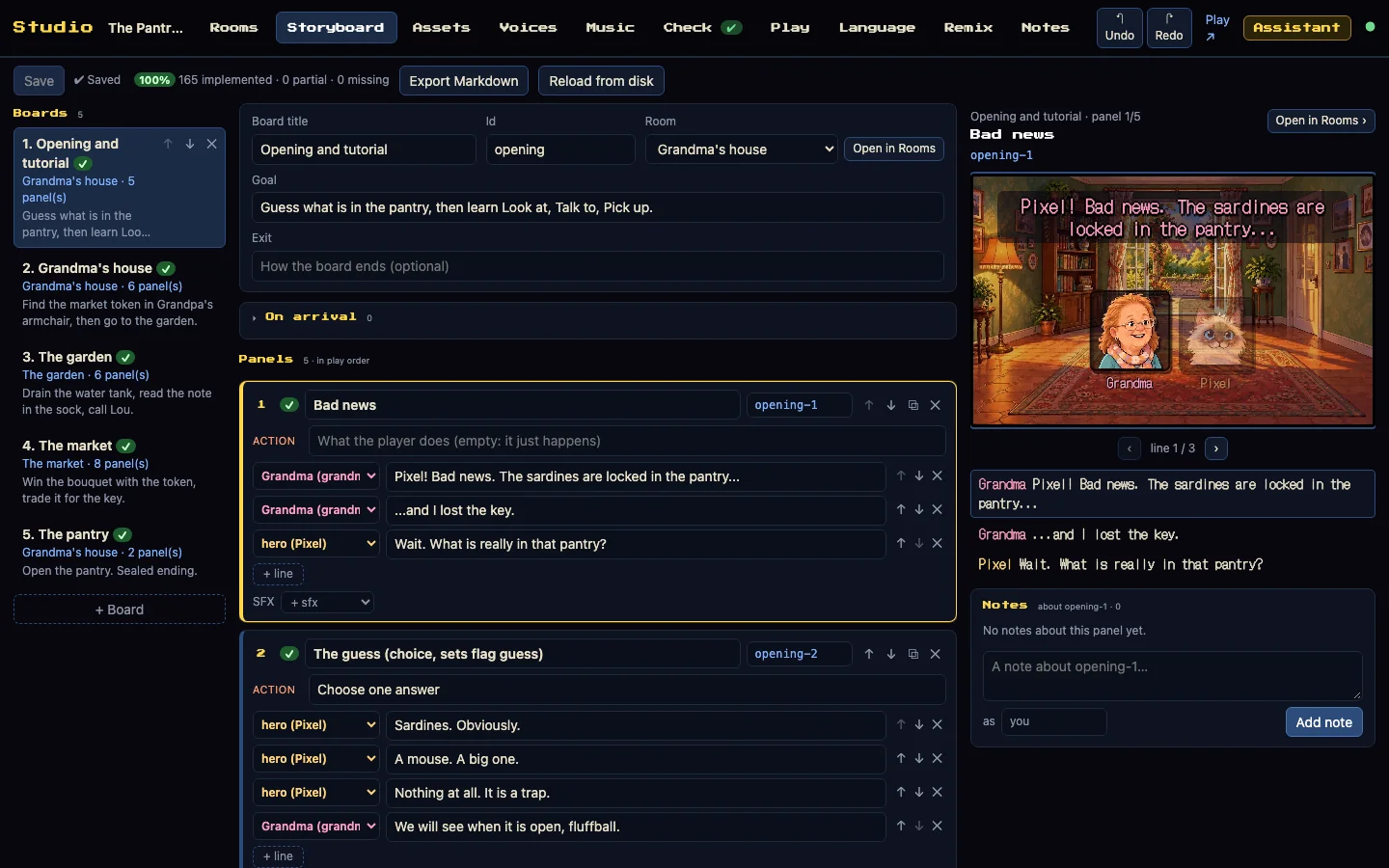
The Storyboard tab. 100 % — 165 implemented, 0 partial, 0 missing. Five boards: Opening and tutorial, Grandma's house, The garden, The market, The pantry. Panel 1, Bad news, with Grandma's and Pixel's lines; on the right the panel's preview and its notes.
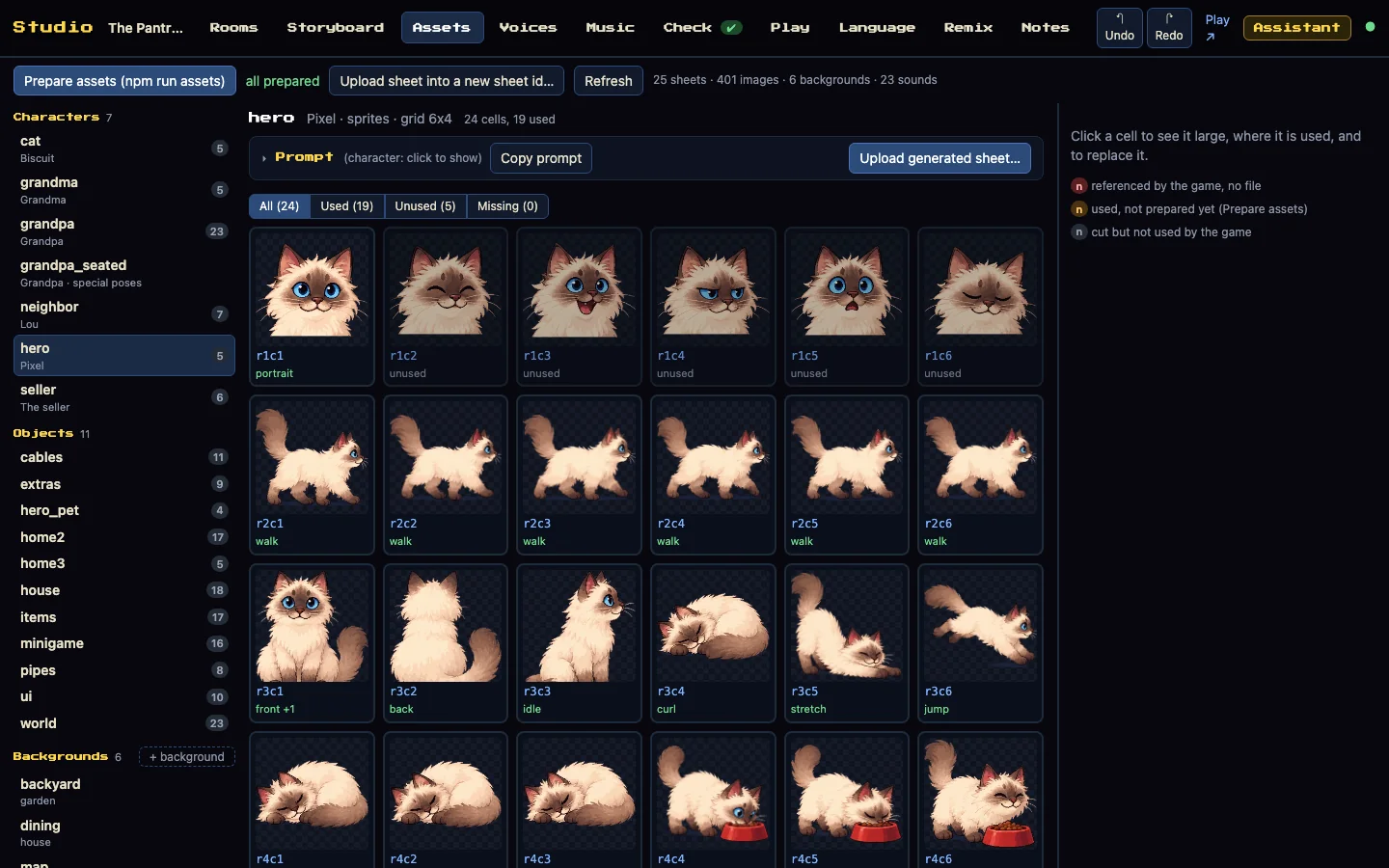
The Assets tab. Prepare assets (npm run assets), all prepared, 25 sheets, 401 images, 6 backgrounds, 23 sounds. The sheet hero (Pixel, a 6 × 4 grid, 24 cells, 19 used): each cell labelled portrait, walk, idle, curl… or unused; Copy prompt and Upload generated sheet….
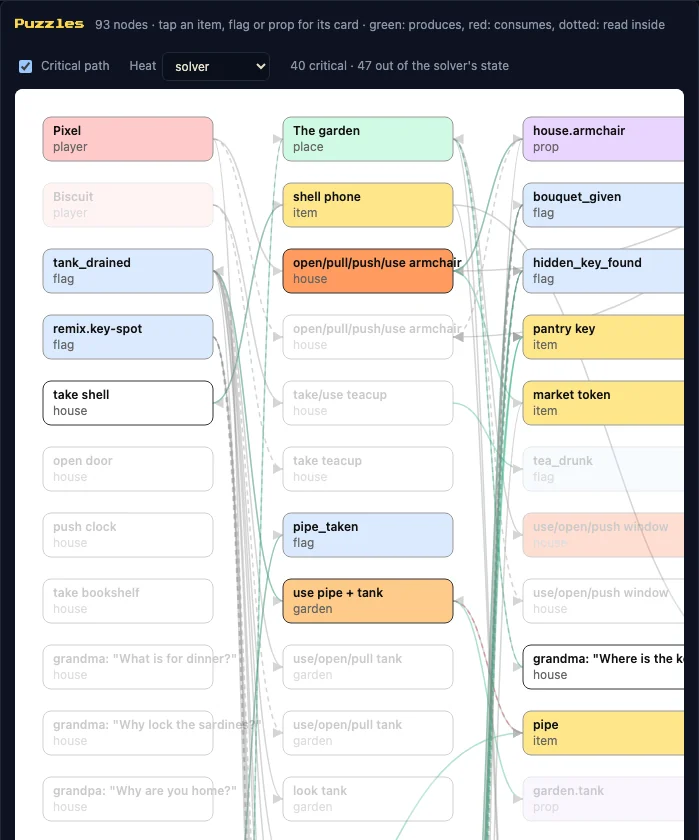
The puzzle graph (Check tab). 93 nodes; green arrows produce, red ones consume. Critical path on: 40 critical, 47 out of the solver's state; nodes such as tank_drained, shell phone, use pipe + tank, pantry key.
Not shown yet
No capture here shows these screens, each one the decisive step of a recent flow:
| Screen | Since | Where to see it today |
|---|---|---|
Choosing the hero at New Game, in two languages (games/heroes) | 4.3.0 | Choosing the hero |
| The Studio's Voices tab, "Heroes × languages" matrix | 4.4.0 | The hero × language matrix |
| Before/after captures in the semantic diff (local Studio) | 4.4.0 | the local Studio |
| A hosted Studio: a member's edit refused with 423, the hosted preview, the Check tab after a save | 4.2.x | 423 on the hosted Studio |
npm run docs:screenshots cannot take them as it stands: it plays the sample game, The Pantry Key, and opens four
tabs of the local Studio on it; it has no step for games/heroes, for the Voices tab or for a hosted Studio. Taking
them means adding those steps to the script, then placing each capture in the page of its flow.
Taking them again
# in the engine repository, after npm ci and npx playwright install chromium
npm run docs:screenshots
It builds the game into .cache/docs-dist, plays the sample game through the end-to-end harness and drives the Studio
with Playwright, then writes WebP files named for the release that took them (4119-<name>.webp at 4.1.19); a
release's captures never overwrite another's. --only=game|studio takes one half; --keep-png keeps the raw
captures. The script: scripts/docs-screenshots.mjs.